


Your shopping cart is empty!
Zonal Pelargonium "Raffaella Pink" F1
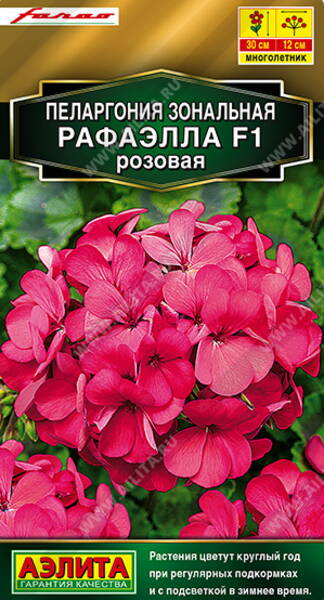
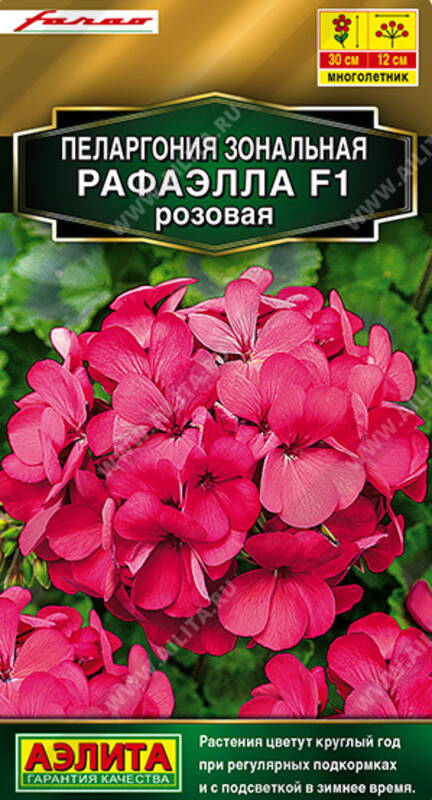
Zonal Pelargonium "Raffaella Pink" F1 (Geranium) - Pelargonium zonale.
A perennial houseplant and an annual for the garden.
The new hybrids of the "RAFFAELLA" F1 series are a chic example of modern breeding: their beautiful, compact bushes 30 cm high are well branched, look strong, thick and dense, with magnificent spherical inflorescences (about 12 cm in diameter).
Grows easily and quickly from seeds – shoots appear in 1-1.5 weeks, blooming at an early stage of development. In the phase of one or two true leaves, the seedlings are pricked out. When the seedlings reach 8-10 cm, the tops of the shoots are pinched to stimulate branching.
Universal application: potted indoor cultivation, on sunny balconies, and as an annual in garden flower beds.
The plants are not only resistant to heat but also tolerate short-term temperature drops well. With proper care (regular feeding and additional lighting in winter), they bloom all year round.
Sowing: grown through seedlings.
Seedlings are pricked out in the phase of one or two true leaves. When the seedlings reach 8-10 cm, the tops of the shoots are pinched to stimulate branching. Plant the seedlings in open ground when the threat of frost has passed.
With proper care (regular feeding and additional lighting in winter), they bloom all year round.
A perennial houseplant and an annual for the garden.
The new hybrids of the "RAFFAELLA" F1 series are a chic example of modern breeding: their beautiful, compact bushes 30 cm high are well branched, look strong, thick and dense, with magnificent spherical inflorescences (about 12 cm in diameter).
Grows easily and quickly from seeds – shoots appear in 1-1.5 weeks, blooming at an early stage of development. In the phase of one or two true leaves, the seedlings are pricked out. When the seedlings reach 8-10 cm, the tops of the shoots are pinched to stimulate branching.
Universal application: potted indoor cultivation, on sunny balconies, and as an annual in garden flower beds.
The plants are not only resistant to heat but also tolerate short-term temperature drops well. With proper care (regular feeding and additional lighting in winter), they bloom all year round.
Sowing: grown through seedlings.
Seedlings are pricked out in the phase of one or two true leaves. When the seedlings reach 8-10 cm, the tops of the shoots are pinched to stimulate branching. Plant the seedlings in open ground when the threat of frost has passed.
With proper care (regular feeding and additional lighting in winter), they bloom all year round.
* Seed propagation of pelargonium is very profitable: despite the comparative high cost of seeds, they have a high germination rate and allow you to get a large number of seedlings; compact, beautiful bushes with an abundance of large flower caps grow from the seeds.
Pelargonium seeds are large, covered with a dense leathery shell. It takes 5-6 months from sowing seeds to the beginning of flowering. Pelargonium seeds can be sown throughout the year if additional lighting is available in autumn and winter. Usually, amateur flower growers sow pelargonium from November to April.
It is better to sow pelargonium in February-March (by the time of germination and the beginning of seedling growth, the daylight hours increase).
The soil for sowing pelargonium should be loose, moisture- and air-permeable. To compose the substrate, you can use high moor peat, perlite, leaf and humus earth, and sand. For sowing pelargonium seeds, experts recommend the following substrate composition: turf earth, sand, and peat in a ratio of 2:1:1. Before sowing, it is advisable to disinfect the substrate (you can spill it with a pink solution of potassium permanganate, or a solution of the biofungicide "Fitosporin-M"), because pelargonium seedlings are susceptible to "blackleg" disease.
To accelerate the germination of collected pelargonium seeds, experienced flower growers scarify them (rub them with fine-grained sandpaper to remove the cover scales and slightly break the cover shell). Seeds prepared for planting germinate in 7-10 days, and without pre-sowing treatment, their germination is not uniform and can drag on for up to 3 months. Seeds that have already been cleaned of cover scales go on sale, they germinate in 2-3 weeks.
F1 pelargonium hybrids grown from seeds can subsequently be propagated only vegetatively, because the seeds obtained from them will produce segregation in subsequent generations (plants grown from them will not be similar to the mother plants). Seeds formed on varietal pelargoniums under favorable growth conditions as a result of artificial pollination, insect pollination, or self-pollination can be used for sowing. They are collected from plants in summer or early autumn, after the seed pods turn brown.
Pelargonium seeds are sown in boxes and bowls filled with a moist substrate, sprinkled with a thin layer of substrate or sand 2-5 mm thick, sprayed from above after sowing and covered with glass. It is required to ventilate the seedlings daily by raising the glass and wiping it from condensation.
For pelargonium seeds to germinate, it is required to maintain a temperature of +18...+22°C and regularly moisten the drying substrate. The bowl with emerged seedlings is placed in a bright place; with sufficient lighting, the seedlings grow strong and stocky, developing rapidly.
After the emergence of seedlings, it is important to maintain moderate soil moisture and prevent it from drying out, protect the seedlings from direct sunlight, carefully loosen the soil, and ventilate the seedlings.
After 1-1.5 months, when the plants form 2-3 true leaves, the pelargonium seedlings are pricked out into pots, and it is important to plant the plants at the same depth at which they grew earlier. The optimal growth temperature is +16...+20°C.
For better tillering, pelargonium seedlings are pinched over the 5-6th leaf. An abundance of light and fresh air promotes good growth and constant flowering of pelargoniums.
Pelargonium Raffaella Pink F1 seeds: buy in Europe Buy Zonal Geranium Raffaella Pink seeds. Easy to grow from seed, these compact plants offer abundant pink blooms. Perfect for pots and sunny borders.